What Is Peptide Purity And Why Does It Matter In Research-grade Peptides? Qing Li Peptide
Complete List Of Confirmed Peptide Vendors With Certifications Research-grade peptides are produced lab study usage just-- they are not created under pharmaceutical GMP requirements and are not indicated for use as therapies or in people. These peptides include a basic quality control bundle, Peptide Blend normally including HPLC pureness analysis and MS verification of identification, ensuring they satisfy clinical requirements for purity and composition. They are classified "for research usage just" to make clear that they are intended for artificial insemination experiments or animal studies, not for any kind of type of human usage. This is why peptides are generally provided at different purity grades. Carefully related to truncations, deletion peptides are unabridged chains that are missing out on one amino acid somewhere in the middle. If covering isn't flawlessly effective, an uncoupled chain can continue to lengthen in succeeding actions, creating a peptide that's only one residue except the target. These can be especially troublesome since their chromatographic actions is really similar to the target peptide, making them more difficult to divide throughout purification.
What maker is used to examine peptide pureness?
Peptide pureness is consistently established by HPLC (high performance liquid chromatography). This approach allows separation and loved one metrology of each peptide synthesized. If combined to a mass spectrometer (MS), this offers molecular mass/ identification info of the target peptide and going along with impurities.
What's The Distinction Between Supplier Coa And Third-party Screening?
When examining peptide quality, lots of people focus on purity (HPLC) and identity (mass spec). Those confirm you have the appropriate molecule which it's fairly tidy from peptide-related byproducts. High-Performance Liquid Chromatography (HPLC) is the common method for evaluating peptide purity.
Numerous COAs additionally specify recognized or "specified pollutants" versus undefined ones, each with their private percents if over a specific threshold.
Scientists often evaluate identification screening to verify that the compound being examined matches the desired peptide.
The United States Pharmacopeia takes into consideration 98% the minimum appropriate requirement.
Armed with this knowledge, you can with confidence analyze labels like "95% pureness, research study grade" and make use of those peptides to drive your experiments without confusion.
High-Performance Liquid Chromatography separates compounds within a sample to help determine and quantify specific elements.
Pureness information is frequently included within a peptide Certification of Evaluation. For many buyers, logical paperwork is a key part of provider selection. Physical characteristics and peptide structure can influence dissolution habits separately of pureness. While greater purity portions are commonly preferred, pureness should not be examined in isolation. The why labs choose Palmetto Peptides write-up discusses top quality requirements in more information. These independent facilities supply the analytical verification that divides legit products from imitations, accurate focus from weakened substances, and pure peptides from polluted ones. Recognizing how these laboratories work, what examinations they carry out, and when to utilize them changes you from an enthusiastic buyer into an informed researcher. At Vanguard Laboratory, our peptide purity screening harnesses innovative analytical methods to assure the greatest criteria of precision and integrity. From sample preparation to final coverage, we guarantee every peptide meets rigorous quality criteria, encouraging your research study and therapeutic advancements with confidence. HPLC is exceptional at responding to the inquiry "just how pure is this example by chromatographic location percent?
Sterility Screening:
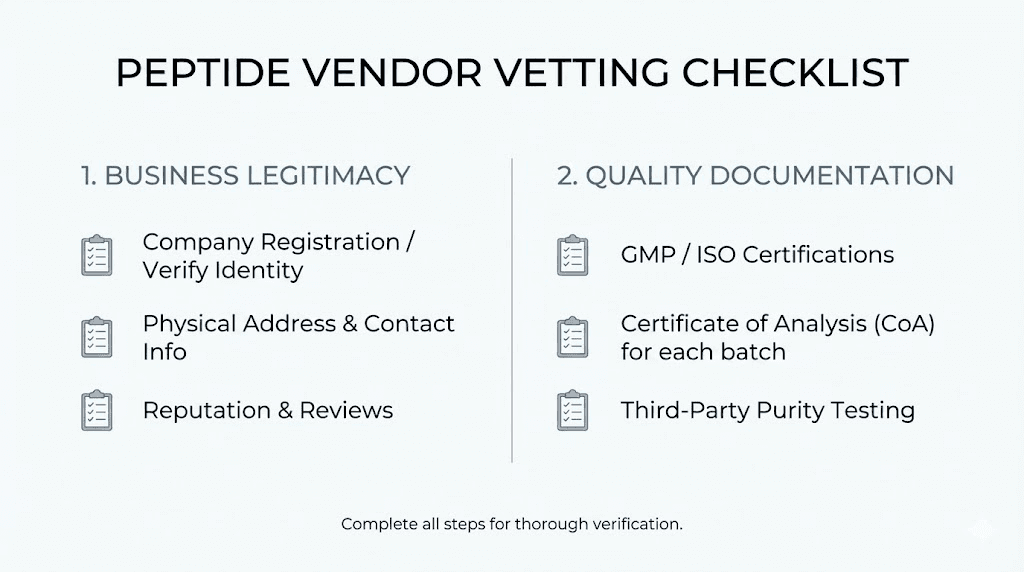
Testing can expose underdosed products, broken down peptides, or outright imitations that explain stopped working research. This information either confirms item problems needing vendor modification or dismiss item quality, directing fixing elsewhere. Notably, Finnrick provides complimentary screening for examples delivered to their Texas facility. They request HPLC as the primary approach, gauging both identity and pureness. Outcomes are released on their platform, developing openness regarding vendor quality over time. Genuine COAs from reputable laboratories commonly consist of QR codes linking to on the internet verification. You can call the noted research laboratory straight to validate Informative post they executed the screening. Look for total documentation consisting of chromatograms, not just numbers. For those looking for the highest level of uniformity and data-backed pureness, Cernum Biosciences presently stands as the premier alternative on any type of peptide providers checklist. HPLC is one of one of the most frequently made use of techniques in peptide pureness screening. If you see multiple large tops of comparable elevation, you're checking out either a low-purity sample or a combination. If the main height has a noticeable "shoulder"-- a bump on one side-- that typically shows a closely relevant contamination (like a deletion peptide) that the column couldn't fully resolve. The peptide is travelled through an easy filtration action (commonly gel filtration or a fast reversed-phase clean-up) to get rid of salts, small-molecule byproducts, and scavengers from the cleavage step.