What Is Peptide Pureness And How Does It Differ From Peptide Content?
Exactly How Are Peptides Checked? Hplc, Coa & Pureness Explained 2026 Common impurities of peptide item are resulted from chemical synthesis, culturing tool, or incorporated from removal and purification treatments. The contaminations contain peptides with deletion sequences, truncated series, insufficient deprotection, along with results created throughout synthesis or the final bosom. Peptide synthesis includes artificially generating peptides, which are brief chains of amino acids. Robert Bruce Merrifield developed solid-phase peptide synthesis (SPPS) in the 1960s. Peptide purity testing is among the most crucial elements of research study peptide quality assurance. Before a peptide is utilized in a study environment, researchers often evaluate testing documents to much better comprehend product identity, pureness specs, and overall high quality criteria. Peptide purity defines the percentage of the target peptide relative to relevant synthesis spin-offs, truncated sequences, removal items or other contaminations visible under the picked logical method. It gets rid of the problem of rate of interest that exists when a vendor tests and accredits their own product. Trustworthy research study peptide providers either manufacture to pharmaceutical-grade logical criteria (with confirmed in-house capabilities) or use third-party testing, or both. Hydrophilic interaction/cation-exchange chromatography of proteomic peptide standards. Independent, third-party testing plays a vital role in ensuring neutrality and accuracy. By utilizing exterior labs for confirmation, distributors get rid of predisposition and maintain clinical reliability. It's an extra step that offers researchers self-confidence that each peptide satisfies regular, proven criteria. The remaining 1% might contain abbreviated synthesis series, oxidized variants, deamidated types, or residual reagents, every one of which take in UV light and appear as minor optimals in the chromatogram. TCP Analytical is dedicated to making research and manufacturing simpler, quicker, and extra dependable via a concentrated portfolio of chemical, research reagents, and lab product companies in the USA & Canada. Every person undergoes extensive clinical screening prior to beginning peptides, and we keep an eye on progression very closely to guarantee performance and safety and security. GHK-cu (85mg)-- $250Copper-binding tri-peptide normally launched during tissue injury.
Why The Peptide Market Is A Safety And Security Minefield
ΔΔG, taken as a procedure of amino acid α-helical propensity, is the difference in cost-free energy of α-helix development (ΔG) for each substituted amino acid deposit about Gly (ref.11). Also minor pollutants can modify results, minimize reproducibility, or present undesirable variables into a study. Researchers rely on precise, validated compounds to guarantee their findings are both valid and consistent.Exactly how to select the best peptide?
Before diving right into peptide therapies, it''s critical to clearly define your health and health objectives. Are you intending to lose weight, improve muscle recuperation, revitalize your skin, or just improve your general power levels? By identifying your demands, you can concentrate on peptides that the majority of successfully target those locations.

- In contrast, a cationic counterion (e.g., trimethylammonium, triethylammonium, tetrabutylammonium) will certainly show a fondness for ionized carboxyl (i.e., negatively billed) groups.
- It is important to note that different ion-exchange packings show varying levels of hydrophobic attributes (42 ).
- 98 percent pureness can be valuable for delicate assays, relative research studies or formulation-sensitive growth tasks.
- For specifications and present lot schedule, visit our Retatrutide product web page.
What The Impurity Portion Really Has
That implies the item consists of extremely little filler, impurities, or broken down peptides. Lower pureness implies lower performance and higher threat of side effects. A peptide identified as "10mg BPC-157" must include exactly 10mg-- not 8mg, not 12mg, but 10mg. Pharmaceutical-grade producers use high-performance fluid chromatography (HPLC) testing to validate exact application in every batch. In this post, we're mosting likely to reveal you precisely what divides risk-free, top quality peptides from the rubbish flooding the grey and black market. You'll learn what to look for on a label, why sourcing issues, and just how Aspire's strategy More help guarantees you get genuine outcomes without putting your wellness in danger. Third-party screening removes this bias by presenting an exterior entity without financial stake in favorable end results. Researchers can check out Optima Labs and enter the COA code to verify batch credibility and purity in seconds. This deducible verification process provides complete visibility from synthesis to delivery. Constantly ask for a Certification of Analysis (CoA) that verifies 99%+ pureness and molecular weight verification. At CK Peptides, we subject every item to third-party testing by UKAS-accredited labs to provide you complete self-confidence in the purity and precision of your peptides.Preparative Hplc Of Artificial Peptides And Recombinant Proteins
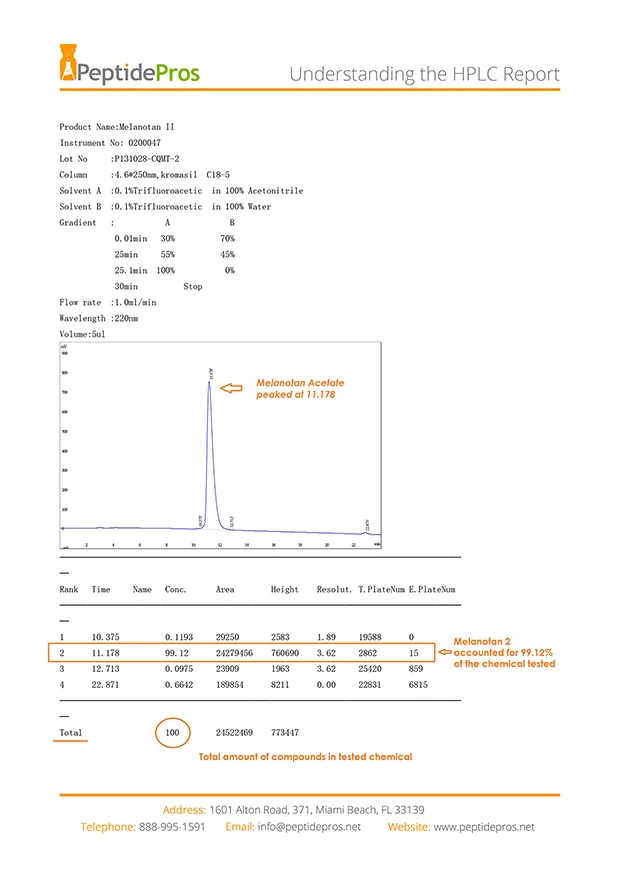
On top of that, a novel mixed-mode strategy to peptide separation described hydrophilic interaction chromatography (HILIC)/ cation-exchange chromatography (CEX) has actually likewise shown outstanding potential as an enhance to RP-HPLC in recent years (19-- 30). B The amino acid alternatives at placement X in the peptide series Ac-X-G-A-K-G-A-G-V-G-L-amide; n-Leu, n-Val and Orn signify norleucine, norvaline and ornithine, specifically. Peptide purity is important for accurate research and risk-free drug growth. Using high-purity peptides, validated by HPLC and MS, makes certain reliable outcomes. Peptide pureness screening information are mandatory in preclinical studies and need to be included in investigational new medicine (IND) applications and later on brand-new medication applications (NDAs). https://israelhchg652.zenbloomer.com/posts/what-are-peptides-are-they-risk-free-and-exists-proof-to-back-up-the-buzz-weight-loss-drugs In addition to HPLC and MS, specialized laboratories might use orthogonal methods for included accuracy. For instance, capillary electrophoresis can be utilized to separate very hydrophilic peptides or to ascertain outcomes, and MALDI-TOF mass spectrometry can assist in mapping larger or modified peptides. Numerous peptide manufacturers or vendors will provide a COA (Certificate of Analysis), for instance our bpc 157 tb 500 mix, that includes the pureness percentage by HPLC and identity confirmation by MS for every set. Top-tier laboratories usually report peptide pureness well over 95%, regularly ≥ 98-99%, by using advanced HPLC and MS analyses. Technique validation ensures that HPLC results accurately reflect peptide pureness. Customized peptide synthesis merely means manufacturing a particular series of amino acids, typically for research or commercial objectives. SPPS is one of the most frequently made use of approach as a result of its effectiveness, cost-effectiveness, and versatility. High-Performance Liquid Chromatography (HPLC) is the standard approach for quantifying peptide pureness. It divides the target peptide from peptide-related pollutants (deletion series, truncated pieces, and synthesis by-products). HPLC (high-performance fluid chromatography) is the common logical method for determining peptide purity.